

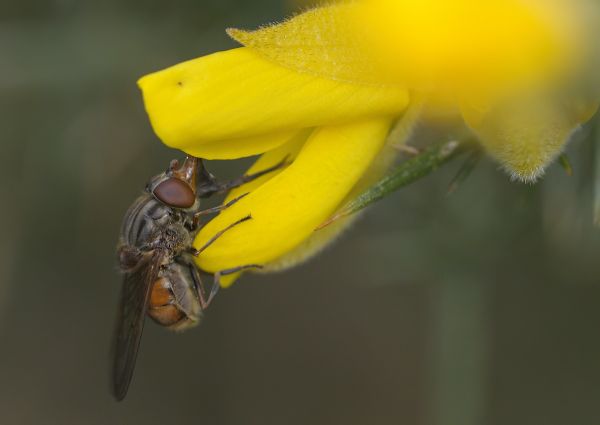

Rhingia campestris Meigen, 1822
Identification
Identification difficulty = 1. 
 according to Ball & Morris, 20241
Biology
The larval biology is described by Coe (1942)2. It develops in cow dung, fragments of which adhere to the body, making them well camouflaged and difficult to detect. The female lays eggs on vegetation overhanging the larval habitat and, on hatching, first instar larvae drop into it. However, adults are found in areas where cattle are absent, raising the possibility that dung of other species, or even other media such as wet compost, may be used. The larvae are filter feeders on microbes which flourish in the wet medium (Rotheray & Rotheray, 20213). Adults occur in meadows, gardens, hedgerows, woodland edges, etc. They are usually seen visiting flowers, especially pink or purple flowers with concealed nectar sources, or resting on vegetation. The long extension to the face, and the long proboscis sited beneath, gives access to deep flowers, such as campions Silene sp., which other hoverflies cannot exploit.
Flight period
The following plots show the number of unique records per week excluding those reported to be of immature stages.

Distribution
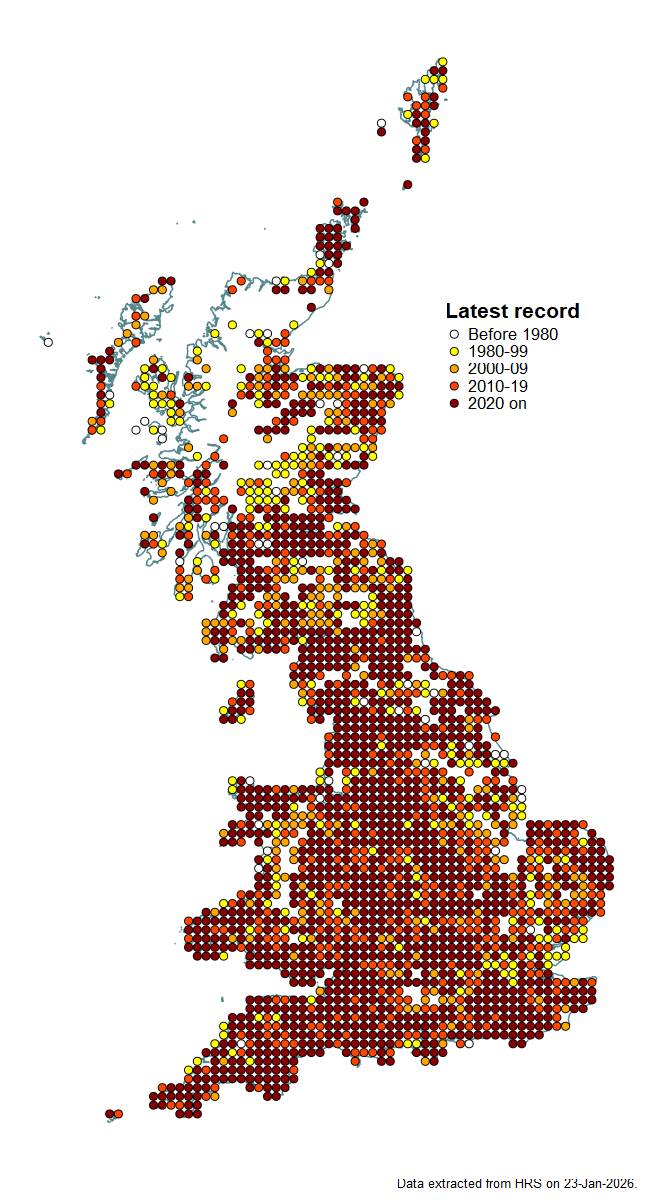
Widespread and very common throughout Britain, including many of the islands, but the numbers of records received per year has fluctuated widely and there is a possibility they are scarcer in the year following a dry season.
Trends
The following plots show the Frescalo TFactor vs year and a map of the rescaled frequency (all records) for the species.
-
Ball, S., & Morris, R. (2024). Hoverflies of Britain and Ireland. WILDGuides (3rd ed.). Oxford: Princeton University Press. ↩
-
Coe, R. (1942). Rhingia campestris Meigen (Dipt., Syrphidae): an account of its life-history and descriptions of the early stages. Entomologist’s Monthly Magazine, 78, 121–130. ↩
-
Rotheray, E., & Rotheray, G. (2021). The puparium and development site of Rhingia rostrata (Linnaeus) and comparison with R. campestris Meigen (Diptera, Syrphidae). Dipterist Digest, 28(2), 127–134. ↩